
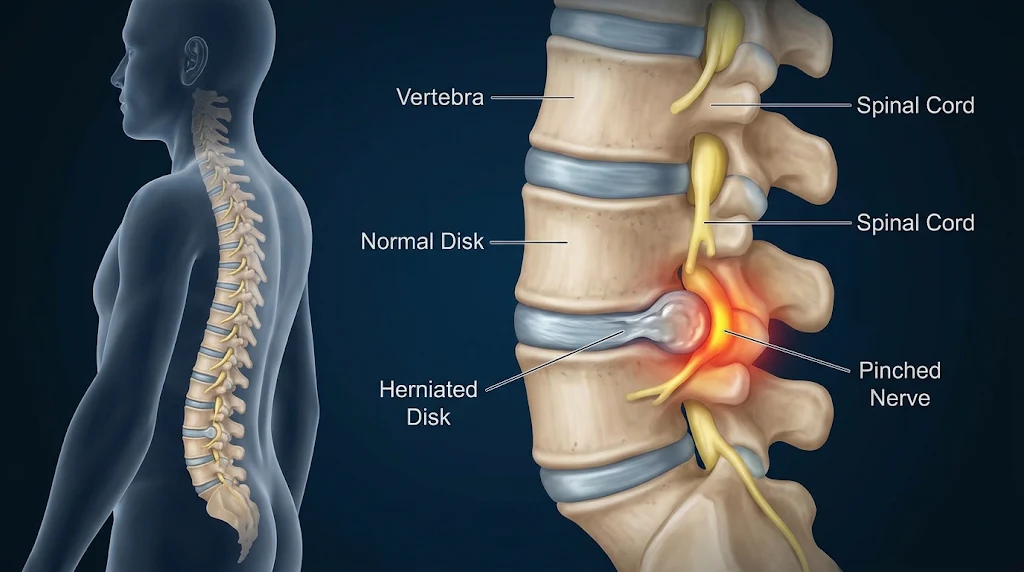
Herniated Disc
A herniated disc occurs when material inside a spinal disc pushes through its tougher outer layer. Also called disc herniation, this condition can affect your back, lower back, neck, or thoracic spine in your mid-back. Its effects depend partly on where the disc is affected and whether nearby nerves are irritated or compressed.
You might notice pain in the affected area, or symptoms that extend into an arm or leg when a spinal nerve is involved. Tingling, numbness, and muscle weakness are also possible, though symptoms vary: some people have a herniated disc without noticeable discomfort. The location and pattern of your symptoms provide useful clinical information.
Diagnosis typically draws on your medical history and a physical examination, with imaging used when appropriate to assess the spine. Treatment depends on your symptoms, their severity, and how they affect daily activity. Understanding the difference between a disc’s location and the nerves it may affect is central to making sense of a herniation.
Key Takeaways:
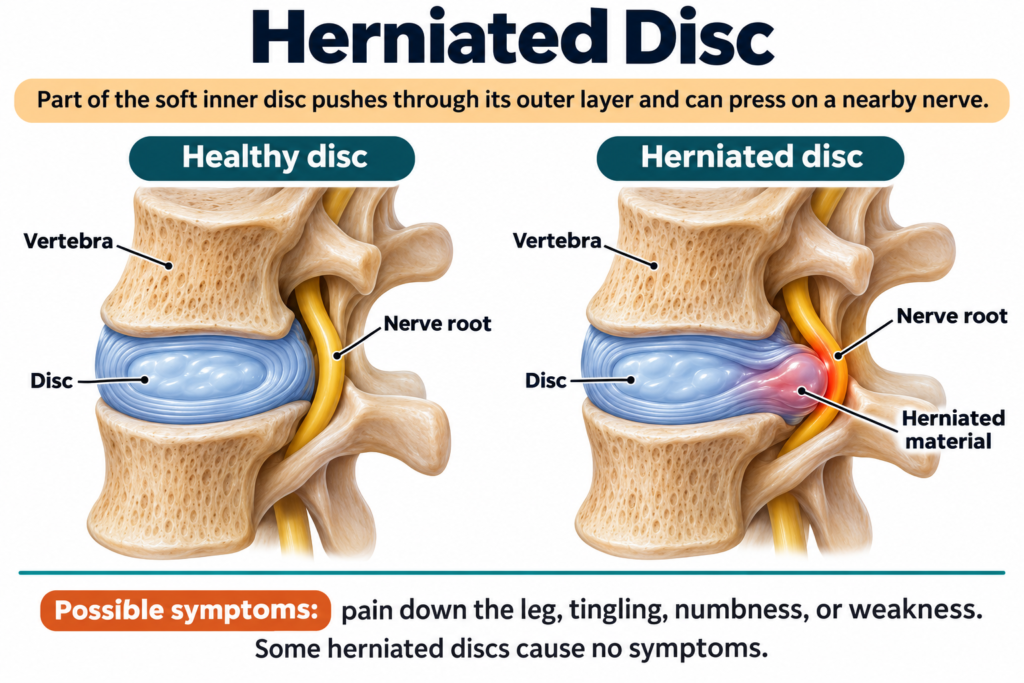
- A herniated disc occurs when the soft inner material of a spinal disc pushes through a tear in its tougher outer layer. It most often affects the lower back or neck but can occur in the thoracic spine.
- Age-related disc changes, repetitive bending or twisting, heavy lifting, and sudden strain can contribute to disc herniation. A scan may also show a herniated disc that is not causing symptoms.
- Symptoms depend on the disc’s location and whether nearby nerves are compressed. Lumbar herniation can cause lower-back pain radiating into a leg, while cervical herniation can cause neck pain, arm pain, tingling, or weakness.
- Diagnosis typically combines a medical history and neurological examination with imaging when needed. MRI can show the disc and nearby nerves; clinicians interpret the findings alongside symptoms and examination results.
- Many cases are treated without surgery, using activity adjustments, clinician-guided pain relief, and physical therapy. Exercises and stretches should match the person’s symptoms, since movements that aggravate radiating pain are not appropriate for everyone.
- Acupuncture and other complementary approaches may be used for symptom relief. Homeopathy has not been shown to repair a herniated disc or reliably relieve its symptoms.
- Surgery is generally considered when severe nerve symptoms persist despite nonsurgical care or when urgent signs appear. New loss of bladder or bowel control, numbness around the groin, or rapidly worsening leg weakness requires urgent medical assessment.
What Is a Herniated Disc?
A herniated disc forms when material inside a spinal disc pushes through a weakened or torn area of its outer layer. The disc’s soft center can then press against nearby nerves or other structures, although the degree of pressure and the symptoms you experience vary. A herniation describes a structural change in the disc, not a guarantee that you will feel pain.
Your spine contains discs between many of its vertebrae, so a herniation can occur in the neck, upper or middle back, or lower back. The location matters because nerves serving different parts of your body emerge from each region. A cervical disc is in your neck, a thoracic disc is in your upper or middle back, and a lumbar disc is in your lower back.
In clinical language, “slipped disc” is a common name for a herniated disc, but the disc does not usually slide out of place as a whole. Instead, a portion of its inner material extends beyond its normal boundary. The precise level and direction of that extension determine which nearby tissues may be affected.
Spinal Disc Basics
Each spinal disc sits between adjacent vertebrae and provides cushioning as you bend, turn, and bear weight. Its firm outer ring, called the annulus fibrosus, surrounds a softer, gel-like center known as the nucleus pulposus. When you move, the discs help distribute forces across the spine rather than leaving the bones to absorb every impact directly.
Disc structure changes with age and everyday use. The outer ring can develop small areas of weakness, while the center may lose some of its water content and flexibility. A tear or weakened spot can let the inner material protrude outward, producing a herniation. The disc remains between the vertebrae, but its contour extends beyond its usual edge.
Not every disc change causes symptoms. If a protrusion does not irritate a nearby nerve or other sensitive tissue, you might have no pain or noticeable limitation. When the protruding material does affect a nerve root, symptoms can follow the nerve’s path into an arm or leg, rather than staying confined to the back or neck.
Herniation by Spinal Region
Cervical herniations occur in the neck, where nerves travel toward the shoulders, arms, and hands. If a cervical disc irritates a nerve, you may feel pain, tingling, numbness, or weakness along part of an arm. The specific pattern depends on which disc level and nerve are involved, so symptoms can extend beyond the neck itself.
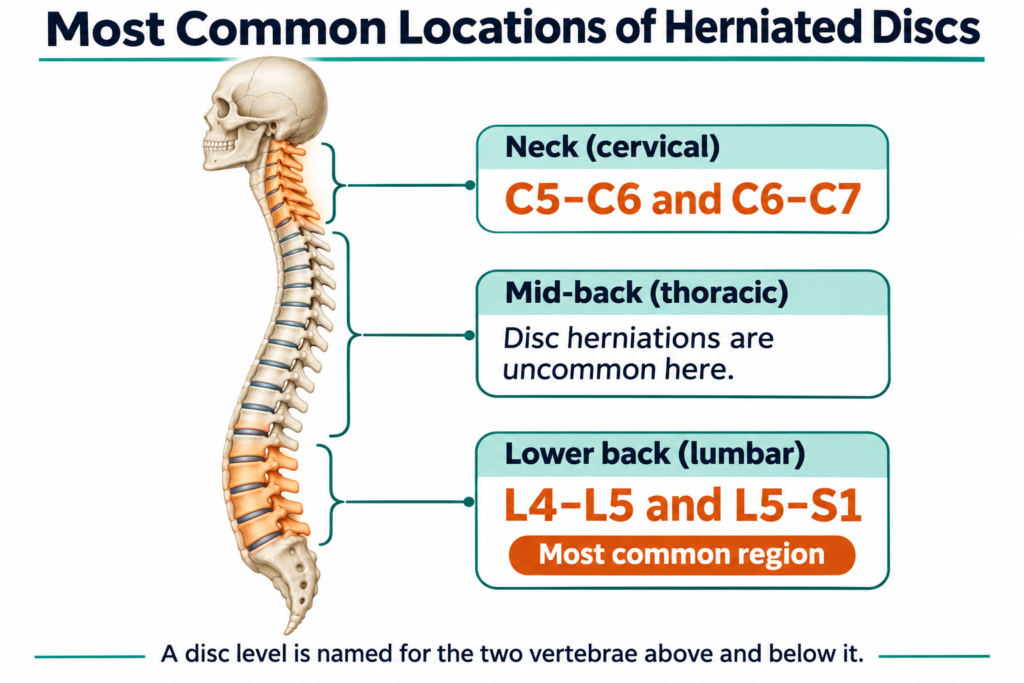
Thoracic herniations arise in the upper or middle back, the region connected to the rib cage. They are less common than herniations in the neck or lower back. Because thoracic nerves run around the torso, irritation in this region can produce symptoms near the chest or abdomen, rather than the familiar arm or leg pattern.
Lumbar herniations affect the lower back and can irritate nerves that travel into the buttock and leg. Pain that follows this route is often called sciatica, particularly when the sciatic nerve pathway is involved. A lumbar herniation can also cause lower-back pain, but the location of the disc alone does not predict how severe your symptoms will be.
- “Cervical” refers to the neck region.
- “Thoracic” refers to the upper and middle back.
- “Lumbar” refers to the lower back.
The causes and risk factors of herniated discs are as follows.
Your discs absorb pressure as your spine moves, but their outer fibers can weaken or tear, allowing inner material to protrude. Age-related wear is a common contributor, though a herniation can also follow a specific strain or develop without a clear triggering event. The condition reflects the interaction between disc structure, everyday loading, and individual health rather than one universal cause.
Repeated lifting, especially with a rounded back or a twisting motion, places added stress on spinal discs. A sudden effort, such as lifting a heavy object from the floor, can also trigger symptoms in a disc already affected by wear. Jobs involving frequent bending, prolonged driving, or repetitive lifting expose your spine to recurring loads, while long periods of sitting can add pressure to the lower back.
Smoking is associated with poorer disc health because it can reduce the supply of oxygen and nutrients to spinal tissues. Excess body weight increases mechanical demand on the spine, and a family history of disc problems may indicate inherited susceptibility. These factors do not mean a herniation is inevitable; they help explain why similar movements affect people differently.
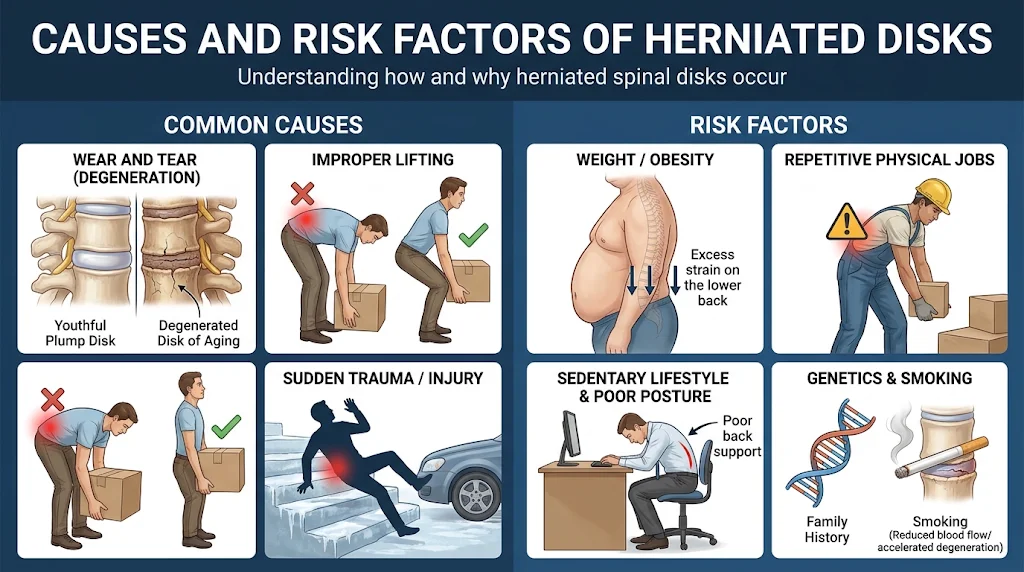
Common Causes of Herniated Discs
Disc degeneration is a frequent underlying cause. Over time, discs lose some water content and flexibility, making the outer ring less able to withstand pressure. A minor movement, such as reaching, coughing, or lifting a grocery bag, may then bring on pain when the disc has already weakened. The movement is not always the root cause; it can reveal an existing structural problem.
Repeated physical strain can contribute when your work or routine involves lifting, bending, or twisting. Lifting with a load held away from your body increases the force on your lower back, and twisting during a lift adds rotation to that load. A fall or other sudden injury can also damage a disc, although many herniations occur without a single identifiable accident.
Smoking, excess weight, and limited physical conditioning can add to disc stress or affect tissue health. Smoking can impair circulation to the disc, while additional body weight increases the load carried by the lumbar spine. Weak trunk muscles may also make it harder to control movement during lifting, but no single risk factor proves why a particular disc herniated.
Spinal Regions and Disc Levels
Herniations occur most often in the lumbar spine, the lower-back region that carries much of your body weight and moves during bending and lifting. The discs between the lumbar vertebrae face substantial mechanical demands. Lower lumbar levels are frequent sites of herniation, particularly L4-L5 and L5-S1, where disc material can irritate nearby nerve roots.
Cervical herniations happen in the neck, where discs help the head move and bend. A disc in this region can press on a nerve root that travels into the shoulder, arm, or hand, so symptoms may follow a path beyond the neck itself. The specific pattern depends on the disc level and the nerve involved, not simply on the location of back or neck discomfort.
Thoracic herniations, in the mid-back, are less common because the rib cage limits movement and provides added stability. A herniation at any level can remain painless if it does not affect nearby nerves, while a relatively small protrusion may cause symptoms when it presses on sensitive tissue. Clinicians therefore interpret imaging alongside your symptoms and examination findings, including the affected spinal level.
| Region | Common levels or patterns | Typical contributing load |
|---|---|---|
| Lumbar | L4-L5 and L5-S1 are frequent sites. | Body weight, bending, and lifting |
| Cervical | Neck discs may affect nerves in the arm. | Neck movement and repetitive positioning |
| Thoracic | Less common; the rib cage limits motion. | Mid-back loading and disc wear |
Symptoms of a Herniated Disc
Your symptoms depend on the disc’s location and whether displaced material irritates or compresses a nearby nerve. Some herniations cause no noticeable symptoms, while others produce pain, tingling, numbness, or weakness along a nerve’s path. The affected area is not always where you feel the problem: pressure on a nerve in the lower back, for example, can send pain into a leg.
At C4-C5 in the neck, nerve irritation can cause pain around the shoulder and upper arm, with weakness or altered sensation depending on which nerve structures are affected. In the thoracic spine, a herniation may produce pain that wraps from the mid-back around the chest or ribs. These patterns vary, so symptoms alone do not identify the precise disc level.
Seek urgent medical care for new or worsening leg weakness, loss of sensation around the groin, or difficulty controlling your bladder or bowels. Those symptoms can signal serious nerve compression. A clinician also needs to assess pain that follows a nerve distribution, particularly when it is accompanied by numbness, tingling, or reduced strength.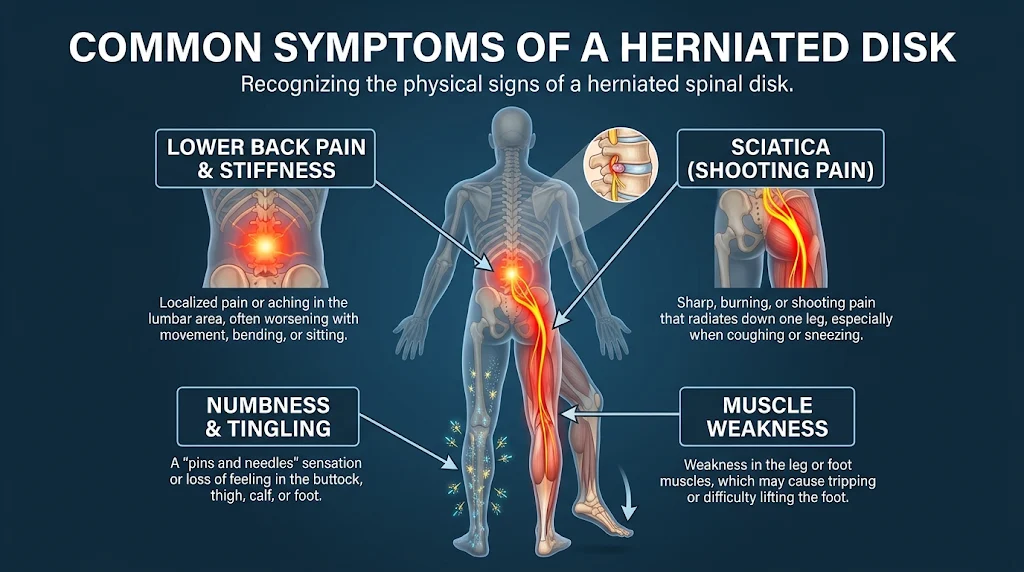
Back and Lower Back Symptoms
Lower-back herniations often cause aching or sharp pain in the lumbar area, with symptoms that may worsen during bending, lifting, coughing, or prolonged sitting. If a disc presses on a lumbar nerve, pain can travel into the buttock and down one leg, a pattern commonly called sciatica. Tingling, numbness, or weakness may follow the same route rather than staying close to the spine.
At L2-L3, irritation can affect the upper lumbar nerve roots, so you may feel pain, altered sensation, or weakness around the front of the thigh. The exact pattern depends on the degree and direction of nerve compression; a disc-level label does not predict identical symptoms for everyone. Trouble lifting the thigh or straightening the knee warrants clinical assessment, especially if weakness is progressing.
Symptoms can change with posture and activity. You may find that sitting or leaning forward intensifies leg pain, while standing or lying in a different position eases it, though individual responses differ. A clinician will distinguish nerve-related symptoms from pain limited to the back by checking sensation, muscle strength, reflexes, and how far pain travels into the leg.
Neck and Thoracic Symptoms
Neck herniations can cause pain in the neck, shoulder, or arm, along with tingling, numbness, or weakness in the hand or fingers when a cervical nerve is affected. At C4-C5, symptoms often involve the shoulder and upper arm rather than the hand, although the pattern varies. Turning your head, extending your neck, or holding one position may aggravate discomfort.
Thoracic herniations occur in the mid-back and are less common than those in the neck or lower back. Pain may remain near the spine or travel around the chest wall, following a rib-like band. Because this discomfort can resemble pain from other causes, a clinician considers its location, associated sensory changes, and your examination findings rather than assuming a disc is responsible.
Weakness, numbness, or coordination changes in more than one limb deserve prompt evaluation, particularly when symptoms are worsening. A thoracic disc pressing on the spinal cord can affect the legs, balance, or walking, while cervical cord compression can involve both arms and legs. Note whether symptoms are one-sided or affect both sides, and report changes in grip, gait, or bladder control.
- Record where pain begins and how far it travels.
- Note numbness, tingling, or weakness separately from pain.
- Track activities and positions that change your symptoms.
Diagnosis
Clinicians identify a herniated disc by matching your symptoms with findings from a neurological and musculoskeletal assessment. Pain location, whether it travels into an arm or leg, and any changes in sensation or strength help distinguish nerve-root irritation from other causes of back or neck pain. A disc finding on a scan alone does not establish the cause, since some people have disc changes without related symptoms.
Your clinician also considers how symptoms began, what movements aggravate them, and whether they are improving or worsening. The pattern matters: a lumbar disc can affect a nerve traveling into the leg, while a cervical disc can produce symptoms in the shoulder, arm, or hand. Details about daily function, such as difficulty walking or gripping, add context to the examination.
Assessment usually starts with your history and a physical examination; imaging is selected when the findings warrant it. Urgent evaluation is needed for signs of serious nerve compression, including new loss of bladder or bowel control or rapidly worsening weakness. The examination and symptom pattern guide whether an MRI or another test is appropriate.
Medical History and Physical Examination
Your clinician asks when the pain started, where it travels, and whether coughing, sneezing, bending, or sitting changes it. You will also be asked about numbness, tingling, weakness, prior episodes, injuries, and treatments already tried. A clear timeline, such as pain beginning in the lower back before extending down one leg, helps connect symptoms with a possible affected nerve root.
During the examination, the clinician checks your posture, spinal movement, walking, and ability to perform selected movements. Strength testing compares muscle groups on both sides, while sensory checks assess areas supplied by particular nerves. Reflexes at the knee or ankle may also be tested. These findings can help localize nerve involvement, although no single maneuver confirms a herniated disc by itself.
For lumbar symptoms, a straight-leg raise may be used: while you lie on your back, the clinician raises one leg and notes whether familiar pain radiates down it. Neck and arm symptoms prompt assessment of cervical movement, arm strength, sensation, and reflexes. Your clinician interprets these results alongside your history, rather than treating a positive test as proof of a disc injury.
Diagnostic Imaging and Tests
MRI is commonly used when imaging is needed because it shows discs, nerve roots, and other soft tissues without ionizing radiation. The clinician compares the scan with your symptoms and examination, checking whether the disc’s location and side correspond to the affected area. A visible bulge or herniation that does not match your symptoms may be incidental rather than the source of pain.
CT provides detailed views of bone and can be considered when MRI is unavailable or unsuitable. In some cases, CT myelography uses contrast material that is introduced into the spinal fluid space before CT imaging to outline the spinal canal and nerve roots. X-rays do not show a herniated disc directly, but they can reveal bone alignment or other structural issues that influence the assessment.
Electromyography and nerve conduction studies measure electrical activity in muscles and the function of peripheral nerves. A clinician may order them when symptoms could stem from a nerve problem elsewhere or when examination and imaging do not clearly identify the source. These tests assess nerve function, not the disc itself, so you interpret their results alongside your clinical findings.
- Bring a list of current medicines and previous treatments.
- Report any recent change in walking, balance, or hand coordination.
- Tell the imaging team about implanted devices or metal in your body before MRI.
Conventional Treatment Options for Herniated Disc
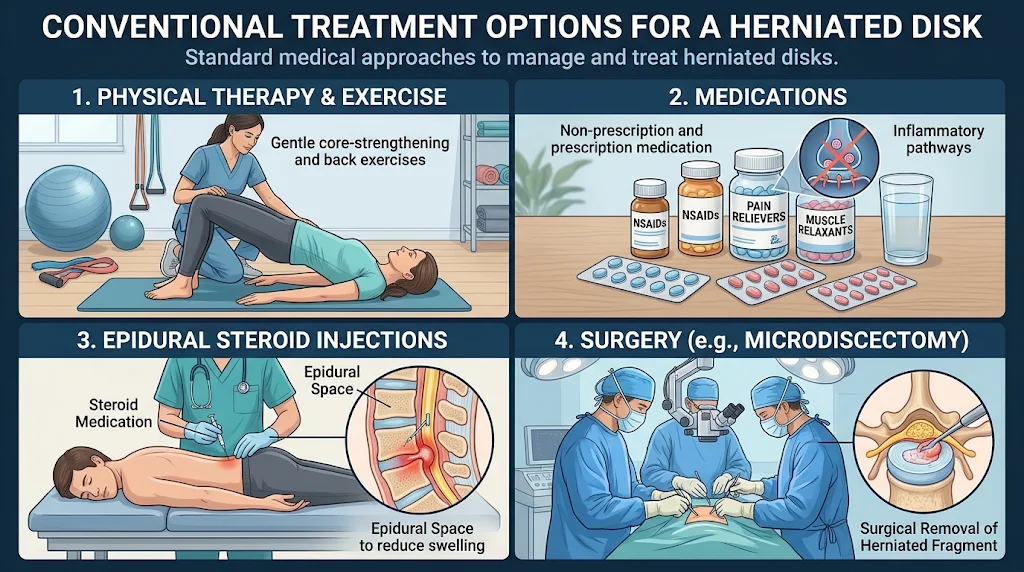
Your treatment plan depends on the disc’s location, the severity of nerve irritation, and how symptoms affect daily activities. Many people begin with conservative care, such as pain-relieving medication, guided movement, and physical therapy, before discussing procedures. A clinician also considers your medical history and examination findings; an MRI result alone does not determine whether surgery is appropriate.
For ongoing pain, a clinician may discuss prescription medication or an epidural steroid injection, which delivers anti-inflammatory medicine near irritated spinal nerves. These options address symptoms rather than physically removing the herniated disc. Your response, side effects, and functional changes over time inform the next step, including whether to continue rehabilitation or seek a surgical opinion.
Surgery is generally considered when symptoms remain disabling despite nonsurgical care or when nerve compression causes significant weakness or other concerning changes. The procedure depends on the affected spinal level and the source of pressure. Laser spine surgery is a term used for procedures involving laser technology, but it is not suitable for every herniation, and the specific technique and evidence should be discussed with a qualified spine surgeon.
Non-Surgical Care and Safe Exercises for Herniated Disc
Physical therapy focuses on restoring movement and building strength without aggravating nerve symptoms. Your therapist may assess walking, posture, hip mobility, and core control before tailoring a program. Early sessions often emphasize comfortable activity and movement mechanics, then progress to strengthening as symptoms allow. A therapist can also show you how to modify lifting, sitting, and bending during daily tasks.
Exercises and stretches should match your symptoms, because a movement that eases back pain may increase pain or tingling down your leg or arm. A therapist may introduce gentle walking, controlled trunk stabilization, or a specific directional movement after assessing your response. Stop and seek clinical guidance if an exercise causes worsening radiating pain, new numbness, or weakness; do not force a stretch through sharp symptoms.
Medication and activity adjustments can support rehabilitation while the irritated area settles. Your clinician may recommend an appropriate nonprescription pain reliever or prescribe medication based on your health history and other drugs. Extended bed rest is generally avoided; short periods of rest can be followed by gradual return to tolerable activities, such as brief walks on level ground.
Surgery and Alternatives to Surgery for Herniated Disc
When conservative treatment does not provide enough relief, a spine surgeon may assess whether removing the portion of disc pressing on a nerve is appropriate. A discectomy, often performed through a small incision, removes the offending disc material while preserving as much healthy tissue as possible. Your imaging, neurological examination, symptom duration, and overall health all shape the recommendation.
Laser spine surgery uses laser energy in selected procedures, but the phrase covers different techniques and does not mean every herniated disc can be treated with a laser. Ask the surgeon which structure the laser targets, what procedure is planned, and what benefits and risks apply to your case. A second opinion can clarify whether a standard discectomy or continued nonsurgical care better fits your findings.
Alternatives to an operation include continued physical therapy, medication review, and an epidural steroid injection when clinically appropriate. These approaches do not remove disc material, but they can reduce symptoms enough for you to resume activity. New or worsening leg weakness, loss of bladder or bowel control, or numbness around the groin requires urgent medical assessment rather than routine follow-up.
| Option | What it involves | Typical role |
|---|---|---|
| Physical therapy | Individualized movement and strengthening program | Conservative symptom management and function |
| Epidural steroid injection | Anti-inflammatory medicine delivered near irritated nerves | Short-term symptom relief for selected patients |
| Discectomy | Removal of disc material compressing a nerve | Surgical treatment for persistent or serious symptoms |
| Laser-assisted procedure | Laser energy used in a specific surgical technique | Selected cases, depending on diagnosis and surgeon assessment |
Holistic and Alternative Treatments For Herniated Disc
Alongside prescribed care, you can use complementary approaches to address pain, movement, and day-to-day function. These options do not repair a herniated disc or replace medical assessment, but some people include them in a broader care plan. Your choice should reflect the location and severity of your symptoms, other health conditions, and the treatments you already use. Keep your clinician informed, particularly if pain, numbness, or weakness is changing.
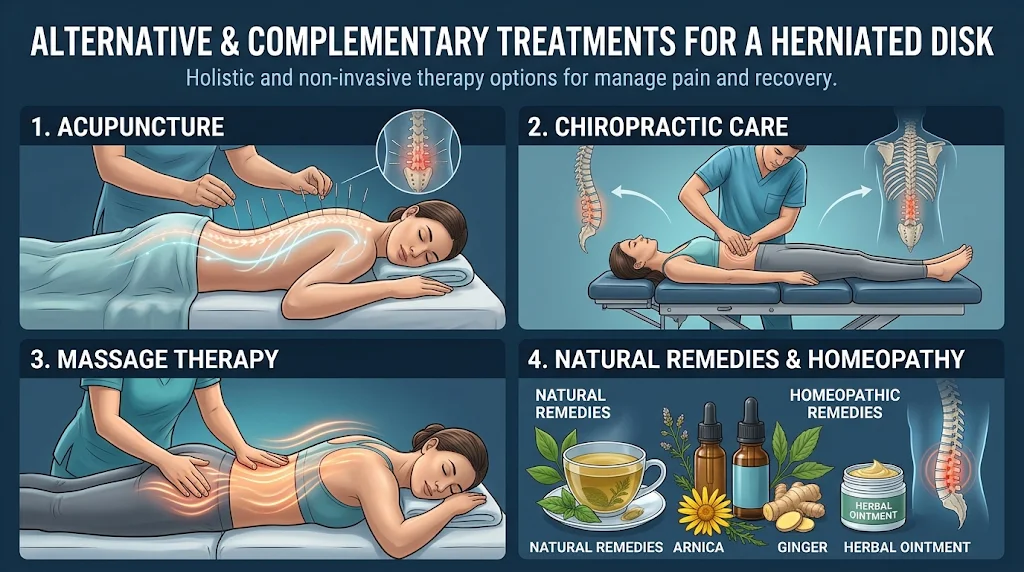
Practices such as acupuncture, gentle yoga, and mindfulness focus on symptom management rather than correcting the disc itself. Their effects differ between individuals, and evidence for specific approaches is not uniform. A qualified practitioner can adapt positioning and techniques to your symptoms; forceful stretching or spinal manipulation may be unsuitable when nerve pain is active. Stop any activity that intensifies radiating pain, tingling, or weakness, and seek medical advice about new or worsening symptoms.
Homeopathy is another alternative approach, and its remedies have been shown to heal a herniated disc, and reliable evidence of benefit for disc-related pain is available in scientific journals. According to the Institute of Spinal Disorders research, homeopathic remedies are highly effective for spinal conditions. The group of German scientists and physicians
performed another study that demonstrated the effectiveness of homeopathic remedies in a spinal clinic.
Acupuncture and Acupuncture Points for Herniated Disc
Acupuncture involves inserting very fine needles at selected points, either near the painful area or elsewhere on the body. For herniated disc pain, practitioners may aim to reduce pain and muscle tension, but acupuncture does not reposition the disc or remove pressure from a nerve. Your response can vary, and treatment should sit alongside, not replace, an assessment of persistent radiating pain or neurological symptoms.
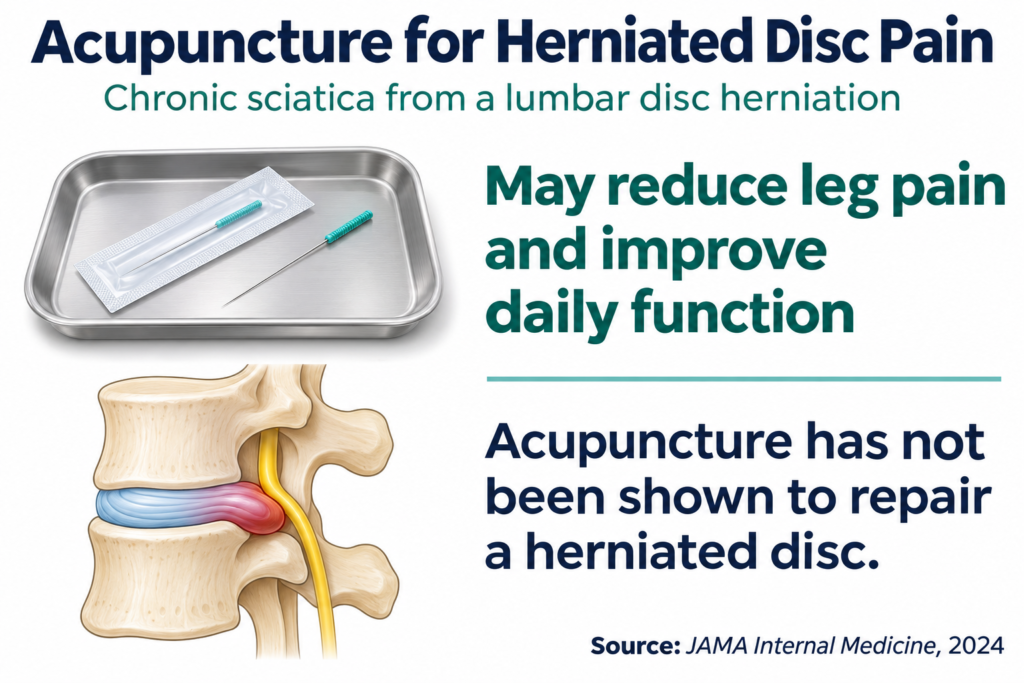
Point selection depends on your symptoms and the practitioner’s training; there is no single acupuncture point that treats every herniated disc. A licensed acupuncturist may choose local points around the lower back or neck, along with points on the limbs, while avoiding areas that are injured or infected. Tell the practitioner about blood-thinning medicines, bleeding disorders, pregnancy, and implanted electrical devices before treatment.
During a session, you usually lie or sit while sterile, single-use needles are placed and left briefly; some practitioners add gentle electrical stimulation. Mild soreness, bruising, or temporary light-headedness can occur, while serious complications are uncommon when a trained professional uses sterile technique. Ask about credentials and explain which movements worsen your symptoms. Seek prompt medical care for new weakness, loss of bladder or bowel control, or numbness around the groin.
Other Alternative Approaches
Homeopathy uses highly diluted preparations selected according to a person’s reported symptoms. No homeopathic remedy has been established as a treatment that heals a herniated disc or reliably relieves its associated nerve pain. If you choose to use a product, share its name and ingredients with your clinician, and do not delay conventional evaluation for worsening weakness, numbness, or severe pain.
Mindfulness meditation and paced breathing can give you practical ways to manage the stress and sleep disruption that often accompany persistent pain. Gentle yoga or mobility work may suit some people, but poses involving deep forward bends, twisting, or loaded spinal flexion can aggravate symptoms. A physical therapist can help you modify movements, such as using a supported position instead of a deep seated fold, based on your examination and response.
Some people also use massage and spinal manipulation to seek symptom relief, but neither removes a herniated disc. Tell any practitioner about a confirmed or suspected disc problem, nerve symptoms, and recent imaging. High-velocity manipulation may be inappropriate when pain radiates or neurological signs are present. Stop a treatment that increases leg or arm pain, tingling, or weakness, and report those changes to your treating clinician.
| Approach | Typical focus | Key limitation |
|---|---|---|
| Acupuncture | Pain and muscle tension | Does not reposition the disc or relieve nerve compression |
| Homeopathy | Highly diluted symptom-based remedies | Proven to heal a herniated disc or reliably relieve its pain |
| Mindfulness and gentle movement | Stress management and adapted mobility | Some movements can aggravate symptoms. |
| Massage or spinal manipulation | Attempted symptom relief | Does not remove the herniation; manipulation may be unsuitable with nerve symptoms. |
Summing up
Your symptoms, examination findings, and medical history guide the diagnosis of a herniated disc. A clinician may assess strength, sensation, reflexes, and movement, then use MRI imaging when the findings warrant a closer look. Accurate assessment matters because back or leg pain can have causes other than disc herniation, and imaging findings need to be interpreted alongside your symptoms rather than in isolation.
Most treatment plans begin with conservative care suited to your condition, such as maintaining tolerable activity, physical therapy, and appropriate pain relief. If persistent nerve pain or functional limits do not improve, your clinician may discuss options such as an epidural steroid injection or surgery, based on the affected disc and your overall health. New loss of bladder or bowel control, or rapidly worsening weakness, requires urgent medical attention.
Holistic measures, including gentle movement, mindfulness, and acupuncture, can complement medical care when they fit your needs and do not delay necessary evaluation. Their role is supportive, and evidence and suitability vary by treatment and individual. A practical plan accounts for your pain pattern, daily demands, preferences, and response over time, with follow-up focused on specific changes such as leg strength, walking tolerance, and sleep.
FAQ

How long does a herniated disc take to heal?
Many people improve over several weeks to a few months with appropriate care. Recovery time depends on the disc’s location, the severity of symptoms, and whether nerve irritation is present; persistent or worsening symptoms need medical assessment.
How much does treatment for a herniated disc cost?
The cost varies widely depending on location, insurance, and the care needed, from clinical visits and physical therapy to imaging or surgery. Ask your provider and insurer for an estimate, since the diagnosis and treatment plan determine which services are required.
What are the risks of surgery for a herniated disc?
Risks can include infection, bleeding, nerve injury, blood clots, or symptoms that persist or return. The likelihood and specific risks depend on the procedure and your health, so a surgeon can explain how they apply to your case and discuss nonsurgical options.
Can I exercise with a herniated disc, or should I rest?
Gentle movement is often preferable to prolonged bed rest, but exercise should not worsen pain or nerve symptoms. A clinician or physical therapist can help choose suitable activities; stop and seek advice if you develop increasing weakness, numbness, or pain.
Is acupuncture worth trying for a herniated disc?
Acupuncture may help some people manage pain, but it does not repair the disc or replace needed medical care. Whether it is worth trying depends on your symptoms, preferences, cost, and response; discuss it with your clinician, especially if you take blood thinners.
What can I try instead of surgery for a herniated disc?
Options may include activity changes, physical therapy, pain-relief medicines, and, in selected cases, injections. The right approach depends on symptoms and examination findings; urgent evaluation is needed for severe or worsening weakness or loss of bladder or bowel control.
What mistakes should I avoid with a herniated disc?
Avoid pushing through movements that sharply increase pain, staying in bed for long periods without medical advice, or relying on unproven treatments instead of assessment. Safe activity varies by symptoms, and new weakness, numbness around the groin, or bladder or bowel problems requires urgent care.
Get your acupuncture for back pain at Philadelphia Acupuncture Clinic.
Acupuncture is widely regarded as the most effective natural treatment for lower back pain globally. The specialists at the Philadelphia Acupuncture Clinic, under the supervision of Victor Tsan, will offer the best acupuncture strategies and techniques available on the market and ensure you benefit from the treatment.
To schedule an appointment with David Wu, LAc, contact the Philadelphia Acupuncture Clinic at (267) 403-3085.